case studies

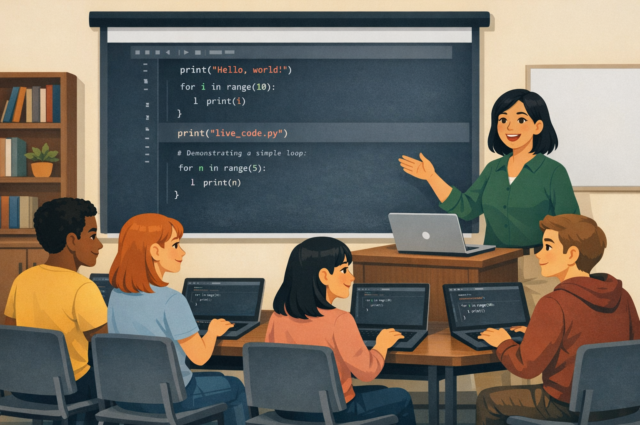
The pedagogic value of Live Coding: Case Study – Civil Engineering

Live coding—where instructors write and execute code in real time while verbalising their thinking—has become an increasingly prominent teaching strategy in STEM disciplines, particularly computer science. It is typically framed as an active learning method that exposes students to authentic problem-solving, debugging, and iterative development practices. This paper reviews the effectiveness of live coding in […]

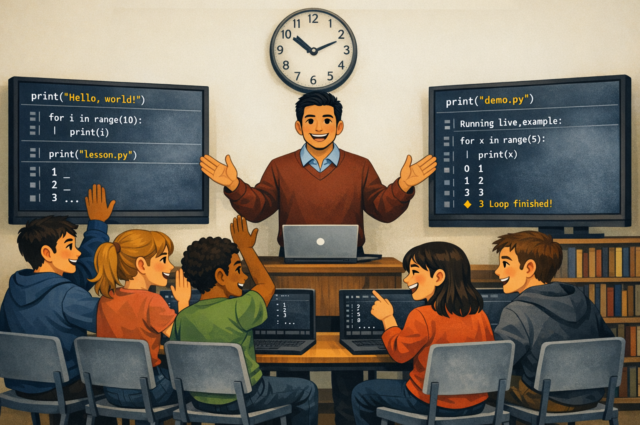
The Pedagogic Value of Live Coding: Case Study – Chemical Engineering

Live coding—where instructors write and execute code in real time while verbalising their thinking—has become an increasingly prominent teaching strategy in STEM disciplines, particularly computer science. It is typically framed as an active learning method that exposes students to authentic problem-solving, debugging, and iterative development practices. This paper reviews the effectiveness of live coding in […]

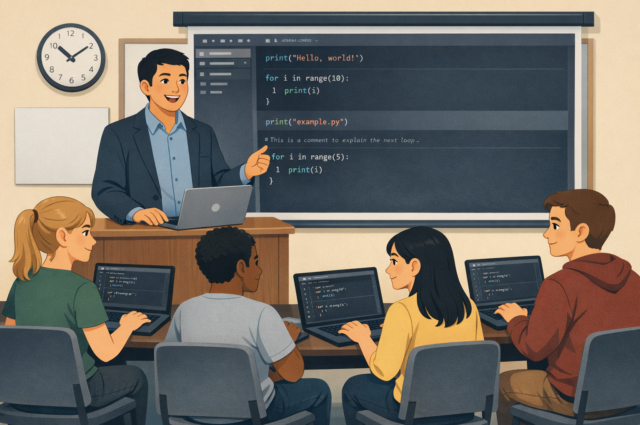
The Pedagogic value of Live Coding: Computer Science

Live coding—where instructors write and execute code in real time while verbalising their thinking—has become an increasingly prominent teaching strategy in STEM disciplines, particularly computer science. It is typically framed as an active learning method that exposes students to authentic problem-solving, debugging, and iterative development practices. This paper reviews the effectiveness of live coding in […]

The Pedagogic Value of Live Coding: Case Study – Physics & Astronomy

Live coding—where instructors write and execute code in real time while verbalising their thinking—has become an increasingly prominent teaching strategy in STEM disciplines, particularly computer science. It is typically framed as an active learning method that exposes students to authentic problem-solving, debugging, and iterative development practices. This paper reviews the effectiveness of live coding in […]

The Pedagogic Value of: Live Coding

Introduction Live coding—where instructors write and execute code in real time while verbalising their thinking—has become an increasingly prominent teaching strategy in STEM disciplines, particularly computer science. It is typically framed as an active learning method that exposes students to authentic problem-solving, debugging, and iterative development practices. This paper reviews the effectiveness of live coding […]

Recognising impact in TLSE: Meet Gregory Lane-Serff

Gregory Lane-Serff, Senior Lecturer in the Department of Civil Engineering and Management, has spent over two decades helping students make sense of complex engineering concepts. We spoke to Gregory to find out how his teaching has evolved and what continues to motivate him after 26 years at the University.

Recognising impact in TLSE: Meet Roshila Moodley

Roshila Moodley, Lecturer in Analytical Chemistry in the Department of Chemistry, is passionate about helping all students feel supported to succeed. We spoke to Roshila to find out how she is supporting MSc students from diverse backgrounds and how targeted funding has helped turn ideas into measurable impact.

The Pedagogical Value of Co-Teaching: Case Study – Computer Science 3

Co-teaching, defined as the collaborative planning and delivery of teaching by two or more educators within the same learning space, is a people centric pedagogic approach than can promote student understanding, a sense of community and inclusion across cohorts as well as increae staff enjoyment of teaching.In this series of Case Studies we talk to […]

Meet Joz Sly, Senior Lecturer and Admissions Tutor for Foundation Year

Having worked at the University for nearly 30 years, Joz teaches Physics on the Foundation Year and plays a key role in widening participation through admissions. We recently met him to find out what he enjoys most about his role, why seeing former Foundation Year students succeed means so much to him and what he enjoys doing outside of the University.