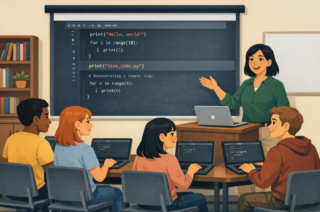
The Pedagogic Value of: Live Coding
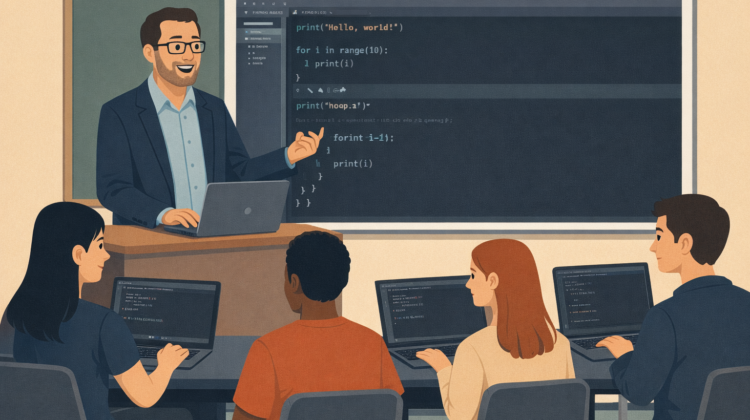
Introduction
Live coding—where instructors write and execute code in real time while verbalising their thinking—has become an increasingly prominent teaching strategy in STEM disciplines, particularly computer science. It is typically framed as an active learning method that exposes students to authentic problem-solving, debugging, and iterative development practices. This paper reviews the effectiveness of live coding in higher education, with a focus on structured pedagogical models and scalable approaches suitable for large, campus-based cohorts.
Benefits for Learning and Engagement
Empirical research consistently positions live coding as a high-impact active learning strategy. It allows students to observe process, not just outcomes—particularly debugging and error recovery, which are often absent in static materials.
Studies show that live coding:
- Enhances engagement and immediacy, as students can influence the direction of the session in real time
- Supports higher-order thinking, such as problem-solving and computational reasoning, through visible cognitive processes
- Provides immediate feedback loops, enabling instructors to adapt explanations dynamically
Live coding also aligns with broader evidence on active learning in STEM, which shows improved performance and retention compared to passive lecture formats, particularly when students are actively involved in constructing knowledge .
Variability Across Learners
Effectiveness is not uniform. Research suggests that:
- Active and visual learners benefit most from live coding
- Reflective learners may struggle with its pace and transient nature
This highlights the importance of scaffolding and multimodal delivery, rather than relying on live coding alone.
Challenges and Limitations
Despite its benefits, live coding introduces several pedagogical and practical challenges:
- Cognitive load and pacing issues for both instructors and students
- Visibility and infrastructure constraints in large lecture halls
- Difficulty monitoring understanding at scale
- Increased instructor stress due to improvisation and unpredictability
These limitations are amplified in large cohorts, necessitating structured models and supporting techniques.
Pedagogical Models for Structuring Live Coding
The “I Do – We Do – You Do” Model
A widely used scaffold models live coding into three phases:
- I Do: Instructor models code and thinking
- We Do: Guided co-construction with students
- You Do: Independent or small-group practice
This gradual release of responsibility helps manage cognitive load and ensures that live coding transitions into active student practice, rather than remaining performative.
Prediction-Based and Peer Instruction Approaches
Embedding prediction prompts during live coding (e.g., “What will this output be?”) increases cognitive engagement and supports conceptual understanding. This technique effectively integrates peer instruction, encouraging discussion and reasoning before execution .
Deliberate Error and Debugging Pedagogy
A distinctive feature of live coding is the visibility of mistakes. Purposefully incorporating errors (“deliberate fumbles”) helps students:
- Develop debugging strategies
- Normalise failure as part of programming
- Build metacognitive awareness
Just-in-Time Teaching (JiTT) Integration
Combining live coding with Just-in-Time Teaching allows instructors to adapt sessions based on pre-class student responses. JiTT creates a feedback loop between preparation and live instruction, improving alignment with student needs .
Studio and Lab-Integrated Models
Live coding is most effective when embedded within studio-style teaching, where short demonstrations are interleaved with hands-on exercises. This hybrid approach mitigates passivity and supports immediate practice.
Techniques for Scaffolding Live Coding
Effective scaffolding is critical, particularly for novice learners:
- Chunking: Breaking sessions into small, concept-focused segments
- Dual-modality support: Providing annotated code, recordings, or transcripts
- Worked examples → partial completion → independent tasks
- Live annotation and narration to externalise thinking
- Pausing protocols: Structured pauses for reflection or replication
Additionally, providing post-session artefacts (e.g., cleaned code or recordings) helps students revisit transient material—a known limitation of live demonstrations .
Scaling Live Coding for Large Cohorts
Scaling live coding to large, campus-based classes introduces unique challenges but also opportunities for innovation.
Distributed Support Models
Large classes benefit from:
- Teaching assistants or peer mentors to support in-class exercises
- Structured breakout activities or tiered support systems
Such approaches are often necessary to maintain engagement and monitor understanding at scale .
Interactive Platforms and Real-Time Feedback
Emerging tools enable synchronous participation at scale. For example:
- Systems like LEAP allow students to run instructor-defined functions and generate real-time analytics on participation and misconceptions
- Live polling, quizzes, and shared coding environments increase interactivity
These approaches shift live coding from a one-to-many demonstration to a many-to-many interactive system.
Live Streaming and Hybrid Delivery
Live coding adapts well to live-streamed environments, where students can interact via chat and shape the session dynamically. This model:
- Reduces preparation overhead
- Enables wider participation
- Supports flexible access
However, it requires careful moderation and platform design to maintain engagement .
Gamification and Engagement Layers
Integrating gamification elements (e.g., leaderboards, challenges) can enhance engagement and performance in programming contexts, though effects on motivation and participation are mixed . These techniques can complement live coding in large cohorts by sustaining attention.
Community and Psychological Safety
Research highlights the importance of creating a supportive classroom climate, particularly in large settings. Students must feel comfortable contributing ideas or making mistakes during live sessions, which is essential for active participation.
6. Discussion
The literature suggests that live coding is most effective when:
- It is embedded within active learning ecosystems, not used in isolation
- Sessions are carefully structured and scaffolded
- Students are actively participating, not passively observing
For large cohorts, the key shift is from performance to participation: scalable live coding requires distributed interaction, technological augmentation, and deliberate instructional design.
Conclusion
Live coding is a valuable pedagogical approach in higher education STEM, particularly for teaching procedural and problem-solving skills. While evidence supports its effectiveness in enhancing engagement and understanding, its success depends heavily on implementation.
Structured models such as I Do – We Do – You Do, prediction-based instruction, and JiTT provide robust frameworks for scaffolding. For large cohorts, combining live coding with interactive technologies, peer support systems, and hybrid delivery models is essential.
Future work should focus on rigorous comparative studies at scale, as well as the development of tools and pedagogies that transform live coding into a fully participatory, data-informed learning experience.
Below is a list of case studies from academic colleagues across faculty who explain how they are putting this theory into practice.
The Pedagogical Value of Live Coding – Case Study: Computer Science
The Pedagogical Value of Live Coding – Case Study: Chemical Engineering
The Pedagogical Value of Live Coding – Case Study: Civil Engineering
The Pedagogic Value of Live Coding: – Case Study: Physics and Astronomy