Staff Guidance: Peer Assessment
Guidance to help you prepare and design your peer assessment activity

Guidance to help you prepare and design your peer assessment activity
Here Fiona Lynch tell us about her experience of applying for SFHEA as a member of PS staff and the benefits it has had for her career development.
Students often print teaching resources out to paper. Sometimes web links cannot be accessed because the full web address is not shown on the course material, and the link cannot be clicked on as with an electronic resource. One possible solution is to include QR Codes within the resource which can be scanned by students using a mobile device to open the web links.
Here we explain the recommended settings to use in order to optimise the teaching and learning experience if you are using Zoom to teach larger groups of students.
Online labs: This page includes a list of external interactive resources for a variety of subject areas.
Using Jupyter Notebooks to teach computational literacy.
Case Study: Until recently, the School of Materials directed learners to paper-based resources to look at weave structures. This was becoming increasingly unpopular with learners, as the books with this information are expensive to buy and are in high demand in the University library.
Celina Jones from the School of Materials contacted the FSE eLearning team to propose the creation of an online catalogue of weave structures.
A full guide detailing how to use Zoom’s many features. This guide includes breakout rooms, polling, essential security tips and cloud recording.
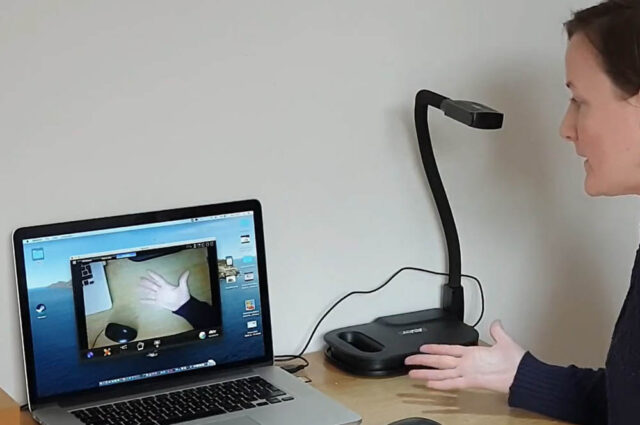
This webpage details how to use a visualiser to display a real-time image of what is underneath the document camera.
This is the second in a multi-part article about displaying mathematical notation within web pages.