Being an EDIA team intern
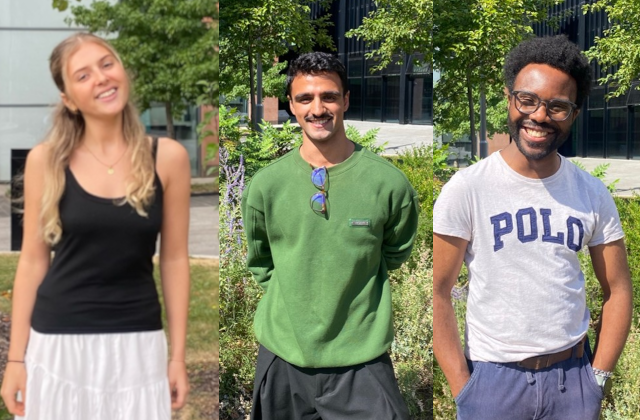
Over the summer, the Equality, Diversity, Inclusion and Accessibility (EDIA) Team in the School of Natural Sciences welcomed three student interns to work on projects exploring what inclusion looks like across our School. In this blog, they share what they worked on, how they brought their own experiences as students within the School to the work, and what surprised them along the way!
Georgia-Mai Sharples – BSc Fashion Marketing
Hello, I’m Georgia-Mai! Currently a 3rd Year BSc Fashion Marketing student about to go into my 4th and final year at The University of Manchester. I have just completed a study abroad year in Hong Kong at the Hong Kong Polytechnic University, allowing me the opportunity to study & explore fashion in a country closely linked to the supply chain process. By wanting to focus on social sustainability within the supply chain and manufacturing process, this internship has allowed me to merge my passion for sustainability and social responsibility within the curriculum and apply my pre-existing knowledge in the context of the School.
During my summer research internship, I assisted in helping map where EDIA, sustainability, social responsibility and ethics are incorporated into the curriculum. Me and my fellow intern (Sid) divided the workload, each focusing on 3 of the departments, which for me included: Chemistry, Materials and Earth and Environmental Sciences. As he is a student from the Department of Chemistry, we thought it would be interesting to switch courses and therefore reflect our findings for each other’s department – being able to see an outsider’s perspective and avoid bias. The objective of this project was to easily identify where these themes are currently already integrated across the school, allowing a clear departmental picture of strengths in these areas and therefore highlighting weaknesses and where these themes could be improved upon.
I have really enjoyed learning about the processes behind the scenes – understanding why certain measures are put in place and seeing how EDIA and other themes are introduced across departments beyond Fashion Business Technology. This project has also built my confidence considerably: conducting meetings with senior academics I probably wouldn’t otherwise have had the chance to meet allowed me to expand my network, while also learning a great deal about their roles and the modules they teach, which being outside of my own department, I had no prior knowledge of. I found it really refreshing to converse with academics, specifically lecturers and unit coordinators regarding the units they teach and see the passion they each had for their own subject. Often feeling like a private lecture when they would discuss their modules with me, I really enjoyed talking to them 1-1, something I plan to expand on in my final year, by making the most of teaching hours and actually going to speak to my lecturers if I want clearer guidance. As an undergraduate considering postgraduate research, this internship has given me invaluable experience in conducting my own research, which I can carry forward in future.
Initially, I came into this internship with an expectation that EDIA would be widely incorporated across all SoNS departments, something I quickly found not to be the case. I believe the FBT department has always done an excellent job of embedding these themes into our course curriculum, but when I started to look into other departments it was clear to me that it did not naturally lend itself to some of the other departments quite so easily. I found the online course information pages to have only a base level of information about these topics and it wasn’t until I spoke directly with academic staff that I got a much clearer picture of different ways these themes could be included in the curriculum that I had not initially considered. I hope mine and Sid’s mapping of these themes allow for a clear highlight of where they are exemplified and areas that may be lacking or need further support.
Sidarth Surya – MSc Chemistry with Medicinal Chemistry
Hi I’m Sid! I’m an incoming 4th year studying Chemistry with Medicinal Chemistry! Since 2nd year, I’ve been on the Chemistry EDIA Committee as an Undergraduate Representative given my role as Inclusion Officer in Chemistry Society; I’ve co-organised and volunteered to help out at events the committee have held, including the Chemistry Speaks project organised by Dr. Roshila Moodley. My research interests lie in computational chemistry (many people who know me know that I can’t stop talking about it) and my long-term goal is to work in the pharmaceutical industry in cheminformatics and supporting early drug discovery trials, particularly in women’s health – I’d love to work on a project relating to endometriosis/PCOS screening, since I know a couple of close friends who suffer from these conditions.
The project that Georgia and I are working on is mapping out the curriculum across all six departments in SoNS, split between us equally. We aimed to find out more about how inclusive the curriculum in these departments are by looking at the units that cover EDIA, sustainability from the United Nations Sustainable Development Goals, social responsibility/ethics and employability skills. It was interesting to look at the departments outside of Chemistry, and with Georgia being a Fashion Marketing student, we were able to share our experiences with these themes in our time of study.
I’ve learned a significant amount of what goes on behind the scenes to improve EDIA culture in SoNS; in my first week I attended the UoM Teaching and Learning Conference to understand how academics incorporate inclusive teaching practices, which served as great preparation. I’ve also appreciated what the FBT, Physics and Maths departments have come up with to contribute more of these themes to the curriculum and outside – some of it has served as inspiration to ask if it can be used in the Chemistry department! For some subjects it’s not always easy to notice these themes, however from the meetings I’ve had with Departmental Heads of Education, Programme Directors, EDIA, Sustainability and Disability Audit Officers, there are some themes that certain units do focus on in great detail, which was eye-opening. Some unfortunately don’t include it yet, but they are actively trying to make progress to modify their unit to include these themes to a stronger standard than before, which was very optimistic to hear! I’ve also enjoyed experiencing what it’s like to work as part of a professional team while maintaining a better work-life balance (something I don’t always manage!) Since I was also working simultaneously as a summer intern with the Trujillo research group for 4 weeks, I’ve managed to find some habits during that time to support my mental health and wellbeing, I really appreciate the team’s flexible working arrangements and have been enjoying the yoga classes offered by UoM Sport, which Hannah very kindly directed me to.
Initially I thought that all the departments I was mapping would contain a lot of information on EDIA, but from looking at online course information webpages and chats with Department Heads of Education, it was less in that case. It did make the workload a little bit harder, but I wanted to convey to not only to the SoNS EDIA team these findings, but also informally to course mates and lecturers in and out of the Chemistry department. I also believe that the resources that Georgia and I created could offer the relevant departments more information on what units show a strong case of these themes and where more attention needs to be brought to each year and its curriculum.
Faisal Giwa – PhD student in BioDesign and Engineering
Hello there! I’m Faisal, a final year PhD student in BioDesign and Engineering. My main academic interests include anything to do with translational protein engineering; so, designing specialist proteins that can help address impactful societal challenges. I see myself going into scientific policy once I’ve completed my PhD. Despite being a public tool, I think science presents a lot of barriers to participation for the average person. Therefore, I would like to work on delivering a legal framework where the thoughts and opinion of the public help guide the scientific identity of our country, so that science can better serve the public. In my spare time, I’ve really gotten into home fermentation, and am toying with the idea of starting a kombucha business side-gig!
My project has been centred on understanding the experience of Black heritage students in the School of Natural Sciences, looking at how different aspects of students’ identities intersect to shape their experiences in SoNS. For example, I’ve analysed student voice data to see how ethnic identity, gender and fee-status are impacting the experience of students in SoNS with keen attention to exploring the data on Black women students’ experiences. I have been taking a data forward approach to see where students of certain backgrounds report having a noticeable deprecated experience relative to their peers so support the team in building actions that better support the student community for their upcoming Athena Swan submission. I’ve also assisted the team with their internal and external communications and have started on planning our upcoming Black History Month programme.
I have really enjoyed understanding the process behind how the University goes from feedback and opinions to tangible action. I did not understand how EDI initiatives were organised at the administrative level prior to working in EDI. It’s nice to know that we have a lot of student-led projects that the school is well in support of. The thing I have enjoyed the most however is just being a part of the SoNS EDI team. Research can feel a little isolating sometimes, so it’s been nice to feel like I’ve been a part of a team delivering on real change within the University. Working in EDI has also really put into perspective my own values, and what it is I want to work on when I leave university.
I think working in EDI has shown me that institutions need to meet people where they are at in matters of EDI. As an intern and EDI representative, I’ve seen the best and worst of EDI practices; be it in work or education, we’re all impacted by a complex mixture of things that are within and outside of our control. As institutions, we need to be proactive in making informed decisions about how to deliver an equitable work/education experience and even pre-empt challenges that may raise barriers to participation.
One thing I’ve learnt is that communications and how we market what we do really matters! At first, I saw that our external communications were basically non-existent. It was hard to prove to someone external to the university the breadth of EDI work happening within the School. I think if we better communicated our values that would feed into a better culture overall. One challenge I came across in my role was that so many students just don’t take the student surveys, which makes it hard draw decisive conclusions from the responses. We need to show people that when you engage with the university through feedback, we action it!
A massive thanks to Georgia, Sid and Faisal for their brilliant work with us! If you’d like to hear more about our work or how you can get involved, please email natsci-edi@manchester.ac.uk