
Making mathematics more accessible: Meet Donald Robertson
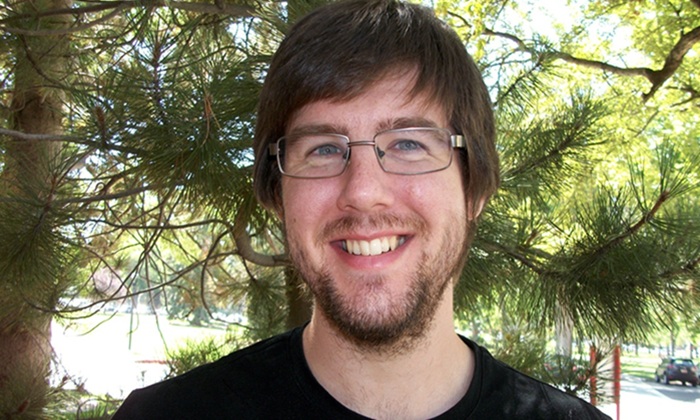
Donald Robertson, Senior Lecturer in the Department of Mathematics, has developed an innovative tool to improve how mathematical content is presented and accessed online. Recently nominated for a Distinguished Achievement Award, we spoke to Donald about the inspiration behind his work and what it could mean for the future of accessible teaching.
You’ve developed a tool to make mathematical materials more accessible. What inspired you to work on this?
It’s something I’d been interested in for quite a while. Partly it was about making mathematics more accessible to as many people as possible, but it was also an interesting technical challenge. I’ve worked with both LaTeX and web technologies before and this felt like a natural way to bring those together in a way that could benefit students.
How does your tool improve the way students access mathematical content?
Traditionally, mathematical content is written in LaTeX and then converted into a PDF. That works well for producing high-quality documents, especially for printing, but PDFs aren’t always ideal for reading on a screen. They can be difficult to navigate, especially when zooming, and they don’t always work well with assistive technologies like screen readers. What this tool does is convert that same content into a web page format instead. That makes it much easier to read on different devices, particularly phones and tablets, and it’s more compatible with accessibility tools.
Improving how content is presented can benefit many different students, not just those using assistive technologies
Why is moving beyond PDFs an important step for accessibility?
One of the key issues is how screen readers interpret mathematical content. In a PDF, equations are often not recognised properly, so the software can struggle to read them aloud in a meaningful way. That creates a real barrier for students with visual impairments. By presenting content as a web page instead, we can structure it in a way that makes it more interpretable for these technologies. That was one of the main motivations early on, although I’ve since realised there are wider benefits too.
How did the project develop from an idea to something students are now using?
It started through a working group in the Mathematics Department who were looking at accessibility in teaching. I began exploring whether there were existing tools that could do what I had in mind but I didn’t find anything that quite worked the way I wanted. So I decided to try building something myself. It’s been an ongoing project over the past couple of years – working on it when I could and improving it bit by bit. Now it’s being used in some of our modules, including a large first-year unit with around 550 students as well as a couple of third-year courses, and in collaboration with FSE eLearning there is an online interface to make it easier for colleagues to use the tool.
What has the response been like from staff and students?
Feedback from staff has been really valuable, especially because everyone writes LaTeX slightly differently. When something doesn’t work, I can use that to improve the tool. From the student side, I’ve seen it being used in tutorials often on phones or tablets. That suggests it’s offering something useful, particularly because web pages are generally easier to navigate on those devices than PDFs.
We need to keep thinking about how we present all types of content accessibly, not just equations
What have you learned through working on accessibility in mathematics?
Initially, I was focused on helping students with visual impairments access equations more easily. But as I’ve worked on this more, I’ve realised accessibility is broader than that. Improving how content is presented can benefit many different students, not just those using assistive technologies.There’s also a lot more to be done. For example, diagrams and graphs are still a challenge. Describing those in a meaningful way for someone who can’t see them is quite complex and it’s something we need to think more carefully about.
What do you see as the next steps for this work?
There’s still plenty to improve in the tool itself and it needs more testing and ongoing development. The more people use it, the better it can become. More broadly, I think we need to keep thinking about how we present all types of content accessibly, not just equations. That includes figures, diagrams and other visual elements that are central to how we teach subjects like mathematics.
Finally, how long have you worked at the University?
I joined the University in January 2020 just before everything moved online during the pandemic. Before that I spent about 11 years in the US completing my PhD and postdoctoral research. It was an unusual time to start, but it highlighted how important good digital resources are for teaching and learning.