Decolonising STEM Education
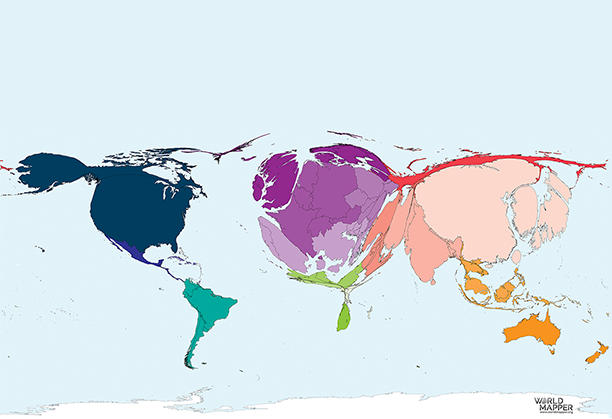
Science papers published in 2016 (worldmapper.org)
Discussions about decolonising Higher Education have become increasingly prominent, yet the term remains widely misunderstood. Too often, it is seen as divisive when, in truth, decolonising is a rigorous intellectual and ethical practice.
While it overlaps with work on equality, diversity and inclusion (EDI), decolonising goes beyond issues of representation to interrogate the foundations of epistemology itself. A decolonial approach asks us to examine how colonial power structures have shaped what counts as legitimate knowledge, whose voices shape our curricula, and how institutions can move towards more equitable ways of teaching and learning.
Understanding Decoloniality
To decolonise education, we first need to understand what colonialism means and how its legacies continue to shape contemporary systems.
- Colonisation refers to the historical processes through which one people occupied and controlled another’s land and resources, typically through violence, expropriation, exploitation and sustained domination.
- Colonialism is the system that sustains that control – through political, legal, cultural and economic structures.
- Neocolonialism describes how former colonies remain influenced by powerful nations and corporations through globalised economies, technology and policy.
- Technocolonialism extends these dynamics into technical, digital and AI systems, where control over data and infrastructure mirrors older patterns of dominance.
- Coloniality looks at how the hierarchies produced by colonialism and the resulting Eurocentric notions of knowledge, culture and authority continue to shape institutions, norms and everyday life on a global scale.
In Higher Education, these structures determine whose belief systems are legitimised and whose are marginalised. In this context, decoloniality seeks to expose and dismantle these hierarchies through an act of epistemic disobedience – inviting us to reject Eurocentric epistemologies as universal, and think critically about how knowledge is produced and shared in our disciplines.
Why Decolonising Matters for Higher Education
Universities have played a key role in building and sustaining colonial systems. From exporting Eurocentric intellectual and administrative frameworks (through subsidiary universities in former colonies) to maintaining material ties with wealth generated by slavery, their influence continues to shape institutional structures today. Many UK universities, including Manchester, are now actively examining how these legacies persist in policies, systems, and curricula.
This reflection is not only historical – it’s about belonging and representation today. A recent survey run by the Students’ Union shows that many students from Black, Pakistani and Bangladeshi backgrounds feel underrepresented or alienated by curricula that continue to privilege Western knowledge systems. Decolonising is therefore integral to inclusive education: it ensures all students see their identities, experiences and knowledge traditions valued.
In this video, our students and staff talk about their experiences, and why they think decolonisation is so crucial and urgent.
What Decolonising Means for Teaching and Learning
Decolonising requires ongoing reflection on what we teach (curricula) and how we teach (pedagogy).
Rethinking the Curriculum
A decolonised curriculum:
- recognises how colonialism shaped academic disciplines
- challenges Eurocentric ideas of progress and universality
- includes diverse scholars and Indigenous knowledge systems
- encourages students to analyse who produces knowledge and why
This is not about erasing white authors or lowering academic standards. It’s about broadening perspectives and deepening critical engagement within our disciplines.
Rethinking Pedagogy
A decolonial pedagogy values dialogue, collaboration and reflection. Drawing on Paulo Freire’s concept of problem-posing education, it reframes students as co-creators of knowledge. It also aligns with andragogy principles in which adult learners’ lived experiences are central to co‑constructing understanding throughout the learning process.
Decolonising pedagogy asks us to move away from a teacher-centred model of education – where teachers transmit knowledge to passive students – towards more learner-centred approaches, where students actively question and co-create knowledge, and apply it to real-world and global contexts.
STEM and The Myth of Neutrality
Science, Technology, Engineering and Mathematics (STEM) fields are often presented as neutral and objective, yet their histories reveal deep links with colonialism. From the Enlightenment onwards, Western science has both benefitted from and reinforced systems of racial hierarchy and exploitation. The very notion of scientific objectivity is a social construct – one historically used to legitimise empire, domination and oppression – from the pseudoscience of phrenology to the biases embedded in Artificial Intelligence.
As Angela Saini notes, even disciplines that appear politically neutral – such as mathematics and statistics – still employ frameworks originally developed by eugenicists and race scientists. From the Industrial Revolution onwards, science has often reflected and reinforced colonial power structures rather than standing outside them.
- Ideas developed to justify the Transatlantic Slave Trade – such as the claim that Black Africans lacked humanity and were “naturally” suited to subjugation – fed into scientific racism, where emerging disciplines like biology and genetics were used to present racial hierarchy as natural and inevitable.
- The pseudoscience of phrenology is an early example: it claimed to measure intellectual capacity from skull shape and consistently ranked White Europeans as superior, providing a “scientific” excuse for slavery.
- These patterns continue into the present: during the Covid‑19 pandemic, higher death rates among ethnic minority communities were initially framed by some as genetic, rather than being linked to structural racism affecting access to housing, employment and healthcare.
- Another, often overlooked, manifestation of cultural imperialism in science is linguistic colonialism. The dominance of English as the global lingua franca in research reinforces colonial hierarchies by privileging certain voices over others.
- Many pillars of Western scientific progress are built on extractive relationships with colonised communities and their knowledge. The discovery and use of quinine, for instance, relied on Indigenous Andean knowledge of the cinchona tree’s medicinal bark. Credit and economic benefits, however, went mostly to European scientists and colonial powers. Specimen-based research in fields like paleontology often began through colonial expeditions that removed materials from colonised lands without consent. These extractive practices persist today in parachute science, where foreign researchers conduct studies in the Global South without collaborating with local scientists or sharing authorship.
Through an intersectional lens, we see how race, ethnicity, class, and gender intersect to influence scientific knowledge and practice. Even medical terminology reveals the persistence of structural bias. The term hysterectomy, for instance, it’s rooted in sexist assumptions about women, reflecting legacies of patriarchy and misogyny. It remains widely used in clinical settings despite uterectomy being a more anatomically accurate alternative.
Encouragingly, science is slowly beginning to confront and shed this colonial past. Institutions are repatriating specimens, building equitable academic partnerships, and expanding access to research infrastructure and technologies. Recognising these legacies challenges the notion that knowledge is culture-agnostic. It invites STEM researchers and teachers to consider how colonial assumptions persist in research agendas, technologies, and teaching practices.
AI Colonialism
Global AI development risks repeating and reinforcing similar patterns of inequality rooted in a colonial past. Unethical systems often exploit digital extraction – energy, labour and data – to enrich the Silicon Valley tech oligarchy. This mirrors colonial extraction of resources and knowledge from the Global South to sustain wealth and progress in the Global North. Algorithmic bias and unequal access to technology further reinforce old colonial hierarchies under the guise of innovation.
Beyond the ethical implications of AI‑driven warfare and defence systems, mass surveillance raises parallel human rights concerns, as powerful governments pursue a digital panopticon to observe and consolidate power. These mechanisms of control extend beyond state security and intelligence infrastructures into everyday life and civil society, where algorithmic systems are used to monitor and classify individuals’ behaviours.
AI may be perceived as neutral because it uses maths and data – equations feel universal, and data looks factual. But equations only work with the data we supply, which is never raw – people with specific worldviews collect, label and interpret it. This structural bias shapes systems, perpetuating inequalities digitally. For instance, facial‑recognition technology proves far more accurate for White faces than Black faces, leading to misidentification and discriminatory policing outcomes. Similarly, predictive‑policing and risk‑assessment models draw on biased law‑enforcement data, reinforcing discrimination. As Patel (2022) argues, racism become encoded directly into technical infrastructures, demanding scrutiny of data production and power dynamics in technology.
Similar patterns also appear in education, where AI tools shape how students learn, and think. Over-reliance on such systems can create AI echo chambers, where filter bubbles reinforce preexisting biases and prioritise comfort over genuine intellectual growth. Supporting students in developing critical AI literacy – to question how data and algorithms shape truth – is vital for nurturing independent, reflective thinkers in an increasingly AI‑driven world.
Without decolonial approaches, AI becomes not a break from empire but its digital continuation.
How to decolonise teaching
Decolonising STEM does not require radical overhaul; small, incremental changes can transform practice over time. Key actions include:
1. Self‑reflect on positionality and inherited assumptions
Examine how your discipline, teaching and research might privilege certain worldviews. Reflect on your own background and role in shaping what and how you teach.
Further guidance: Macro Recommendations on Decolonising the Curriculum
2. Expose colonial histories
Make visible how scientific and technological fields developed within exploitative global systems. Highlight connections between industrialisation, resource extraction, inequality and disciplinary methods.
- Diversify epistemologies and reading lists
Include contributions from underrepresented scholarship (e.g. Islamic mathematicians, African metallurgists, Indigenous ecologists) alongside alternative approaches like Indigenous data governance and ethical AI. Audit reading lists for balance across regions, authors and perspectives. Frame science as a global, intercultural, pluriversal endeavour. - Integrate local contexts
Connect course content to local histories, communities and experiences. Explore how gender, race and class influence participation in your field. - Encourage critical analysis of colonial legacies
Encourage students to examine how colonisation, power and context shaped STEM methods, technologies or data; make criteria explicit and avoid assuming familiarity with unwritten Western academic conventions.
3. Adopt inclusive, flexible teaching methods
Use student‑centred approaches that foster active learning: discussions, problem-solving, co‑teaching and blended formats. Avoid assuming privilege-based access to resources, prior knowledge or unwritten Western academic conventions. Learn to pronounce students’ names correctly. Avoid stereotyping or asking individuals to represent entire groups.
- Invite diverse guest voices
Bring disciplinary and cultural perspectives into face‑to‑face and online sessions through co‑teaching and guest contributors. - Co-design with students
Treat students as collaborators, not just recipients. Invite their input through content co‑creation, feedback loops and student‑led seminars.
Further guidance: The Pedagogical Value of Co-Teaching; Diversifying Knowledge Systems & Teaching Methods (Toolkit)
4. Implement authentic and inclusive assessment
STEM subjects have traditionally favoured limited assessment methods like timed exams, closed-book problem sets and rigid lab reports. These often disadvantage students based on culture, prior schooling or learning preferences. Replace traditional methods with flexible, equitable alternatives that value diverse competencies and enhance employability.
- Use authentic assessment
Use real-world tasks that mirror how scientists, engineers and professionals actually work (e.g., designing experiments, analysing complex datasets, writing grant proposals, creating technical reports for non-experts, collaborating on interdisciplinary problems, presenting findings to stakeholders). These assessments develop employability skills by connecting learning to careers, and help underrepresented students see themselves succeeding in STEM careers. - Embed inclusive assessment
Inclusive assessment broadens what counts as “ability” in STEM and promotes the idea that competence can be demonstrated in multiple ways. Use differentiated strategies (tailoring tasks, formats and support to individual needs while sharing learning goals), mix formats (group projects, lab work, open-book tasks, presentations, posters, videos), share clear marking criteria and exemplars in advance, set real-world challenges, and include rich, personalised self/peer/formative feedback. This maintains high standards, closes attainment gaps, reduces malpractice and unfairness, and helps every student belong.
Further guidance: Assessment Methods (Toolkit); IncludED: Types of summative assessment tasks
Beyond the Classroom: Decolonise blended learning spaces
Digital environments can also benefit from decolonial approaches. From accessibility barriers to biased designed, online learning spaces can replicate exclusion unless intentionally designed. Building equitable, widely accessible digital learning spaces starts with course design and requires a commitment to accessibility by design and Universal Design for Learning (UDL) principles. Key steps include:
1. Design for accessibility
Design for diverse behaviours, not for specific diagnoses.
- Provide materials in multiple formats (readable slides, text, audio, video).
- Ensure all video content has closed captions and transcripts.
- Offer low-bandwidth options (PDFs, audio only, transcripts) and avoid assuming access to premium technology, fast internet or private study space.
- Use plain English wherever possible and inclusive language.
- Use the Canvas course template to ensure consistency and scaffolding.
- Use Canvas accessibility checker tools to ensure content is accessible.
Further guidance: Accessibility in Teaching & Learning; Inclusive Language Guidance
2. Embed Canvas tools to design inclusive assessment
Canvas tools help design assessment that aligns to real-world problems, make marking criteria transparent, and provide students with rich, personalised feedback. These include:
- Online submissions
- Video submissions and quizzing via Studio
- Quizzes
- Rubrics (shared in advance)
- In-line grading
- Voice and video feedback
- Canvas Mastery Paths (tailor assessments based on performance)
- Buddycheck (peer-scoring)
- STACK or Gradescope (complex maths and coding)
Alongside using these tools, it is important to talk with students about AI and LLMs tools – not only in relation to academic integrity and malpractice, but also from an epistemological perspective. Such conversations can help them consider how AI shapes what count as knowledge, evidence and truth, as well as how it can contribute to misinformation within their disciplines.
Further guidance: Canvas Support; Canvas Studio; Artificial Intelligence and Teaching and Learning; How can we develop students’ critical AI literacy?; Book a 121 with eLearning
3. Foster equitable and inclusive participation in digital spaces
Use blended or flipped learning so students can engage at different times and speeds. Offer multiple engagement mechanisms such as online discussions and Mentimeter. Use small breakout rooms and anonymous feedback surveys to ensure equitable participation.
Further guidance: Blended & Flexible Learning Toolkit; Quick Start for Blended and Flexible Learning; Mentimeter
4. Track progress to provide personalised support
Use learning analytics to identify and assist students early, fostering digital spaces where all learners feel supported and included.
Further guidance: Course Analytics in Canvas; Canvas Quiz Analytics; Canvas Individual Gradebook
Conclusion: A shared and ongoing commitment
Decolonising Higher Education is not a one-off project but an ongoing collective commitment to reflection, collaboration, and meaningful reform – one that extends beyond teaching to include research, publishing, and the wider institutional structures of higher education.
By recognising how power shapes what and how we learn, and by acknowledging that understanding emerges from a plurality of experiences and identities, we can build inclusive learning spaces where every student is seen, heard and valued. This work calls for a cosmopolitan approach – one that honours local identities while embracing our shared, interconnected world and affirms that our histories and diverse perspectives enrich, rather than divide, the process of learning.
References
Adebisi, F, Sriprakash, A, Tikly, L, Gournet, M, Eichhorn, S, Krishnan, M & Birdi, A 2021, Decolonising education: from theory to practice, University of Bristol/FutureLearn, viewed 11 February 2026, https://www.futurelearn.com/courses/decolonising-education-from-theory-to-practice.
Adebisi, F. 2020. Decolonisation is not about ticking a box: it must disrupt. [Online]. [Accessed 11 February 2026]. https://criticallegalthinking.com/2020/03/12/decolonisation-is-not-about-ticking-a-box/.
Akinbosede, D 2020, ‘Science curricula must be decolonised too’, Times Higher Education [online], viewed 25 February 2026, https://www.timeshighereducation.com/blog/science-curricula-must-be-decolonised-too.
Arshad, R 2021, ‘Decolonising the curriculum – how do I get started?’, Times Higher Education [online], viewed 25 February 2026, https://www.timeshighereducation.com/campus/decolonising-curriculum-how-do-i-get-started?utm_source=newsletter&utm_medium=email&utm_campaign=campus-weekly&mc_cid=c0f6991ac2&mc_eid=5115ceb94d.
Castro-Gómez, S 2001, ‘Traditional theory and critical theory’, Cultural Critique, vol. 49, pp. 139–154, viewed [date not given], http://muse.jhu.edu/journals/cultural_critique/v049/49.1castro-gomez.html.
Culotta, E, Chakradhar, S & Ortega, RP 2024, ‘Remapping science’, Science, vol. 385, no. 6709, pp. 592–594, viewed 6 February 2026, https://doi.org/10.1126/science.ads2667.
Enslin, P & Hedge, N 2024, ‘Decolonizing higher education: the university in the new age of Empire’, Journal of Philosophy of Education, vol. 58, nos. 2–3, pp. 227–241, https://doi.org/10.1093/jopedu/qhad052.
Fernandes, M 2021, ‘What does decolonising the curriculum mean for STEM subjects?’, Compass: Journal of Learning and Teaching in Higher Education, vol. 14, no. 2, https://doi.org/10.21100/compass.v14i2.1230.
Freire, P 1968, Pedagogy of the oppressed, 3rd edn, Penguin Books, London.
Hao, K, Swart, H, Hernández, AP & Freischlad, N 2022, AI colonialism [online], MIT Technology Review, viewed 25 February 2026, https://www.technologyreview.com/supertopic/ai-colonialism-supertopic/.
Inikori, JE 2002, Africans and the industrial revolution in England: a study in international trade and economic development, [publisher not identified], [place not identified].
Kadour-Peero, E & Dahan, MH 2022, ‘Hysterectomy, a time to change the terminology’, Journal of Psychosomatic Obstetrics & Gynecology, vol. 43, no. 4, pp. 601–602, https://doi.org/10.1080/0167482X.2022.2084377.
Kohnke, L. and Foung, D., 2024. Deconstructing the normalization of data colonialism in educational technology. Education Sciences, 14, p.57. Available at: https://doi.org/10.3390/educsci14010057
Mignolo, WD 2007, ‘Introduction: coloniality of power and de-colonial thinking’, Cultural Studies, vol. 21, nos. 2–3, pp. 155–167, https://doi.org/10.1080/09502380601162498.
Mignolo, WD 2010, ‘Epistemic disobedience, independent thought and decolonial freedom’, Theory, Culture & Society, vol. 26, nos. 7–8, pp. 159–181, https://doi.org/10.1177/0263276409349275.
Muldoon, J & Wu, BA 2023, ‘Artificial intelligence in the colonial matrix of power’, Philosophy & Technology, vol. 36, no. 80, https://doi.org/10.1007/s13347-023-00687-8, viewed 25 February 2026.
Patel, S 2021, ‘Decolonisation of, and anti-racism in, the mathematical sciences’, interview by S Eichhorn, in Decolonising education: from theory to practice, University of Bristol, viewed 10 February 2026, https://www.futurelearn.com/courses/decolonising-education-from-theory-to-practice/1/steps/997102.
Philamore, H 2021, ‘Decolonisation of robotics and artificial intelligence’, interview by S Eichhorn, in Decolonising education: from theory to practice, University of Bristol, viewed 23 February 2026, https://www.futurelearn.com/courses/decolonising-education-from-theory-to-practice/1/steps/997250.
Pimblott, K & Booth, M 2021, Exploring the legacies of slavery and colonialism at The University of Manchester, viewed 12 February 2026, https://sites.manchester.ac.uk/salc-making-a-difference/2021/08/18/exploring-the-legacies-of-slavery-and-colonialism-at-the-university-of-manchester.
Quijano, A 2000a, ‘Coloniality of power, Eurocentrism and Latin America’, Nepantla, vol. 1, no. 3, pp. 533–580.
Quijano, A 2024, Aníbal Quijano: foundational essays on the coloniality of power, W D Mignolo et al. (eds), Duke University Press, Durham, NC, https://doi.org/10.2307/jj.12250639, viewed 9 February 2026.
Research in Practice 2024, Understanding intersectionality, viewed 10 February 2026, https://www.researchinpractice.org.uk/adults/content-pages/change-projects/equity-change-project/intersectionality/understanding-intersectionality.
Santos, B de S 2002, ‘Para uma sociologia das ausências e uma sociologia das emergências’, Revista Crítica de Ciências Sociais, no. 63, pp. [page numbers not available].
Santos, B de S 2018, The end of the cognitive empire: the coming of age of epistemologies of the South, Duke University Press, Durham, NC, viewed [date not given], https://www.jstor.org/stable/10.2307/j.ctv125jqvn.
Science and Engineering Equality, Diversity Hub n.d., How to decolonise the STEM curriculum: a practical guide, viewed [date not given], https://science-engineering.ed.ac.uk/equality-diversity-hub/what-are-we-doing/how-to-decolonise-the-stem-curriculum-a-practical-guide.
The University of Manchester 2021, Researching our early benefactors | Historic links to slavery, viewed 12 February 2026, https://www.manchester.ac.uk/about/history-heritage/historic-links-to-slavery/researching-our-early-benefactors.
United Nations University 2024, What we mean by colonialism & coloniality, viewed 12 February 2026, https://unu.edu/iigh/blog-post/what-we-mean-colonialism-coloniality.
Walsh, C n.d., ‘The decolonial for: resurgences, shifts and movements’, in W Mignolo & C Walsh (eds), On decoloniality: concepts, analytics, praxis, Duke University Press, Durham, NC, p. 17.
Wiley Online Library n.d., article, Science Education, viewed [date not given], https://onlinelibrary.wiley.com/doi/full/10.1002/sce.21474.
Zacek, N & Thakkar, N 2021, Researching our early benefactors | Historic links to slavery | The University of Manchester, viewed 12 February 2026, https://www.manchester.ac.uk/about/history-heritage/historic-links-to-slavery/researching-our-early-benefactors.