Meet Alison Harvey, winner of a 2025 Teaching Excellence award for Educational Leadership

Developed initially for postgraduate researchers, the Responsible Research and Innovation module challenges students to think differently about their research, its wider impact and their role as responsible scientists. Read on to find out what inspired Alison to develop the unit, how students responded to learning beyond their disciplinary comfort zones and what the recognition means to her.
Congratulations on your recent Teaching Excellence Award. Can you tell us a bit about the Responsible Research and Innovation module and how it came about?
Thank you, it really was lovely to receive the award. The module was originally developed as part of my role when I joined the Centre for Doctoral Training (CDT) in Advanced Biomaterials in 2019. All CDTs are required to provide training in Responsible Research and Innovation (RRI) and our CDT decided to take a more ambitious approach by creating a 12-week, 15 credit taught unit. Developing that unit was one of the projects I was asked to lead when I started.
Initially, the timescale was very tight. I joined in August and was teaching the unit by September so it came together quite quickly. But once I started teaching it I realised there was real potential to develop it further.
How did the module evolve beyond its original brief?
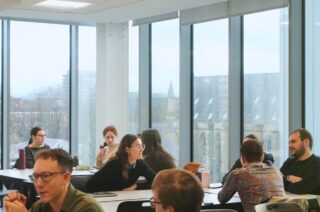
As I taught the unit for the first time I found the topic genuinely interesting myself, but I was particularly struck by how engaged the students were. I’d built quite a lot of space into the sessions for discussion and those conversations quickly became very lively, sometimes even heated, which showed just how much students cared about the issues we were exploring.
Because the students came from science backgrounds – Biology, Chemistry, Materials Science and Physics – many of the topics such as social justice, gender equality in STEM and reflective practice were completely new to them. That meant I needed to draw on teaching approaches more commonly used in the social sciences, which felt challenging at times but also exciting.
Why is Responsible Research and Innovation such an important area for students to engage with?
These topics are becoming increasingly prominent, particularly in relation to global challenges and research funding. Funders such as UKRI now expect researchers to demonstrate how their work considers ethics, sustainability, equality and wider societal impact. RRI helps students understand that their research doesn’t exist in isolation, it sits within a broader social, environmental and ethical context.
We also try to move students away from the idea that RRI is just a ‘tick-box exercise’. It’s much broader than that and can actually open up new ways of thinking about research.
How do students respond to the module and which elements have had the biggest impact?
Many students come into the unit expecting it to be quite dry and are often surprised by how much they enjoy it. While some aspects are challenging, by the end of the unit many students say it is something they really value and can see themselves using throughout their careers and beyond. Reflective practice is one of the most impactful elements and students often say they wish they had been introduced to it earlier. We also encourage them to identify the aspects of responsible research and innovation that resonate most with them whether that is equality, diversity and inclusion, sustainability or public engagement and to build on those interests as they progress, rather than trying to do everything at once.
The module also helps break down assumptions about social science research, giving students a greater appreciation of how complex and rigorous that work can be and why it is essential for truly interdisciplinary research.
What can colleagues and other academics take away from this work?
RRI can sometimes feel like a burden, especially when it appears as an additional requirement in grant applications. That reaction is completely understandable if it’s unfamiliar territory. What we try to show through the module is that RRI doesn’t have to be a barrier, it can actually be a stimulus for research and a way of thinking differently about your work.
We’re now exploring ways to make the materials from the unit more widely available to staff to support colleagues in developing their own understanding of RRI and applying it meaningfully in their research and teaching.
Is the module still being taught?
At the moment, the module itself isn’t running as it was designed specifically for the CDT cohorts and there are no new intakes right now. However, the work has influenced other areas of my role including projects focused on inclusive teaching practices. There’s also a broader move across the University to embed sustainability, EDI and social responsibility into the curriculum which is really encouraging to see.
Were others involved in supporting the development of the module?
Very much so, it was definitely a collective effort. Simon Webb in Chemistry was the RRI lead for the CDT and provided valuable support and sense-checking throughout. We also worked with Benedicte Brahic, an external collaborator from Manchester Metropolitan University who brought a sociological perspective and Chrissi McCarthy, an external EDI consultant from the Centre for Behavioural Equality. The Advanced Biomedical Materials CDT Management Committee was incredibly supportive throughout and provided financial backing to this work.
What did it mean to you to receive the Teaching Excellence award?
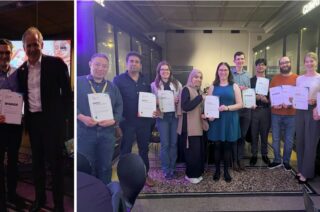
It meant a great deal. I’d actually applied once before and received a commendation along with really helpful feedback. Earlier this year, I realised I’d addressed much of that feedback and decided to apply again. I didn’t realise there were only two individual awards across the University this year so discovering that at the ceremony made the recognition feel particularly meaningful.
It was a wonderful event to attend and incredibly inspiring to see the breadth of excellent teaching and innovation happening across the University. Being recognised alongside colleagues doing such wonderful work was genuinely special.