
Redeveloping the Graduate Teaching Assistant training programme
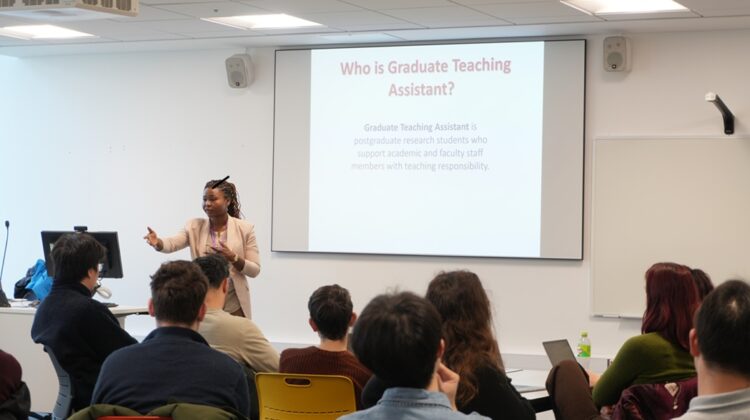
This year has seen a significant redevelopment of the Graduate Teaching Assistant (GTA) training programme, designed to improve clarity, engagement and impact for both GTAs and the students they support. We spoke to Emily Cooksey, Senior Lecturer in Chemical Engineering and Associate Dean for Teaching Academy, and Oli Taylor, CPD Project Coordinator, about why the changes were needed, what’s new and how the programme supports a stronger teaching culture.
What were the reasons behind the redevelopment of the GTA training programme?
Emily: It was a combination of factors. Although registrations for the previous training provision were high, attendance and engagement at the sessions were often lower than expected. At the same time, student feedback from the NSS, unit evaluation questionnaires and student voice committees highlighted some inconsistencies in the support students were receiving which reinforced the need for clearer, more consistent training and guidance for GTAs.
PGR representatives themselves were also telling us that training requirements weren’t very clear. Many GTAs didn’t know what was expected of them or how to engage with the training on offer. Overall, the feedback prompted a careful review of how the existing provision could be improved.
How did you go about reviewing and redesigning the programme?
Emily: We set up a task-and-finish group to review the feedback and explore options for improvement. The group included departmental GTA leads, GTA training facilitators, PGR representatives and professional services colleagues who support GTA contracts and administration. That mix of perspectives was really important as it helped us understand the issues from every angle and shape a programme that works in practice.
What are the main changes that came out of that review?
Oli: One of the biggest changes was around timing and structure. Previously, training sessions were spread across the semester which meant many GTAs had already started or even finished teaching before they could attend. That clearly reduced both relevance and engagement. We’ve now brought the three mandatory training sessions together into a single, structured training day delivered before the start of each semester meaning GTAs complete all essential training before they step into teaching roles. We ran the first session in September, shortly after contracts were issued, and the second will take place in January during the exam period, ahead of Semester 2 teaching.
This new model establishes a clear foundation, ensuring that every GTA completes essential training before beginning their teaching.
How has the content of the training changed?
Oli: One key change has been around feedback and assessment. Previously, training on marking and feedback was optional. Based on student feedback and NSS action plans, we’ve now made this a mandatory session. It focuses on both written and verbal feedback, recognising how important GTAs are in providing formative feedback during teaching sessions.
Emily: That session also looks at increasing opportunities for formative feedback more generally not just through marking, but through discussions and interactions with students. Improving consistency and quality of feedback was a major driver for change.
Were there any challenges in implementing the new approach?
Emily: The biggest challenge has been logistical. Attendance has more than doubled since we adopted this new model which is a very positive outcome, but it also requires careful coordination of rooms, catering, timetables and larger cohorts.
Oli: The training day is intensive, typically running from 9am to 4pm, which we recognise is a significant commitment. However, with regular breaks and a lunch period built in, it provides the most efficient way to ensure all GTAs complete their training before teaching begins.
GTAs are absolutely central to our ability to deliver high-quality teaching. Without them, teaching simply wouldn’t function in the same way.
What feedback have you received so far?
Oli: It’s been really positive. We ran a short post-training survey and the overall rating was around 4.2 out of 5 which we were pleased with. As anticipated, some GTAs did comment on the length of the day, but many also said they appreciated getting all the training done in one go before the semester began.
Emily: From a staff perspective, we’ve had anecdotal feedback from departmental GTA leads that there have been fewer queries and complaints about training requirements. That suggests the new structure is clearer and easier to navigate. We’ll be looking more closely at formal student feedback later in the academic year.
Have you made any adjustments based on that early feedback?
Emily: For the January session that has just taken place, we’ve shortened the introductory and closing sections to make the day feel more streamlined, while keeping the core content the same. There’s a limit to how much we can reduce it but we’ve acted on feedback where possible.
How do you see the programme evolving in the future?
Oli: This new model establishes a clear foundation, ensuring that every GTA completes essential training before beginning their teaching. Beyond that, we’re looking at developing optional, on-demand training opportunities in specific areas of teaching and learning. Many GTAs teach for several years, often on the same units, and they bring valuable expertise. Providing further development opportunities allows them to deepen their contribution and grow their teaching practice over time.
Emily: The programme also links closely to longer-term professional development. The training supports GTAs who want to apply for Advance HE fellowships by introducing them to pedagogy and reflecting on their teaching practice. We proactively signpost them to the GTA strand of the University AdvanceHE Fellowship Scheme and Mentoring Excellence Scheme. Through this combination of support, we’re already seeing increasing numbers progress from Associate Fellowship to full Fellowship. That recognition is really important.
Finally, what role does the programme play in strengthening teaching culture within the Faculty?
Emily: GTAs are absolutely central to our ability to deliver high-quality teaching. I use GTAs myself, and without them, teaching simply wouldn’t function in the same way. Supporting them to be as confident and effective as possible benefits everyone – staff, students and the GTAs themselves.
Oli: Longer term it’s about developing and retaining talent. Many GTAs go on to postdoctoral or academic roles and this programme helps build confidence, familiarity and excellence in teaching as they progress through their careers.
Acknowledgements
The team would like to thank the GTAs, PGR representatives and staff who provided feedback over the past year. Their insights were instrumental in shaping the redesigned programme and ensuring it responds to real needs across the teaching community.